
How to Choose Bagasse Plates for Wedding Catering
· 5 min read · Arrowpack Guides
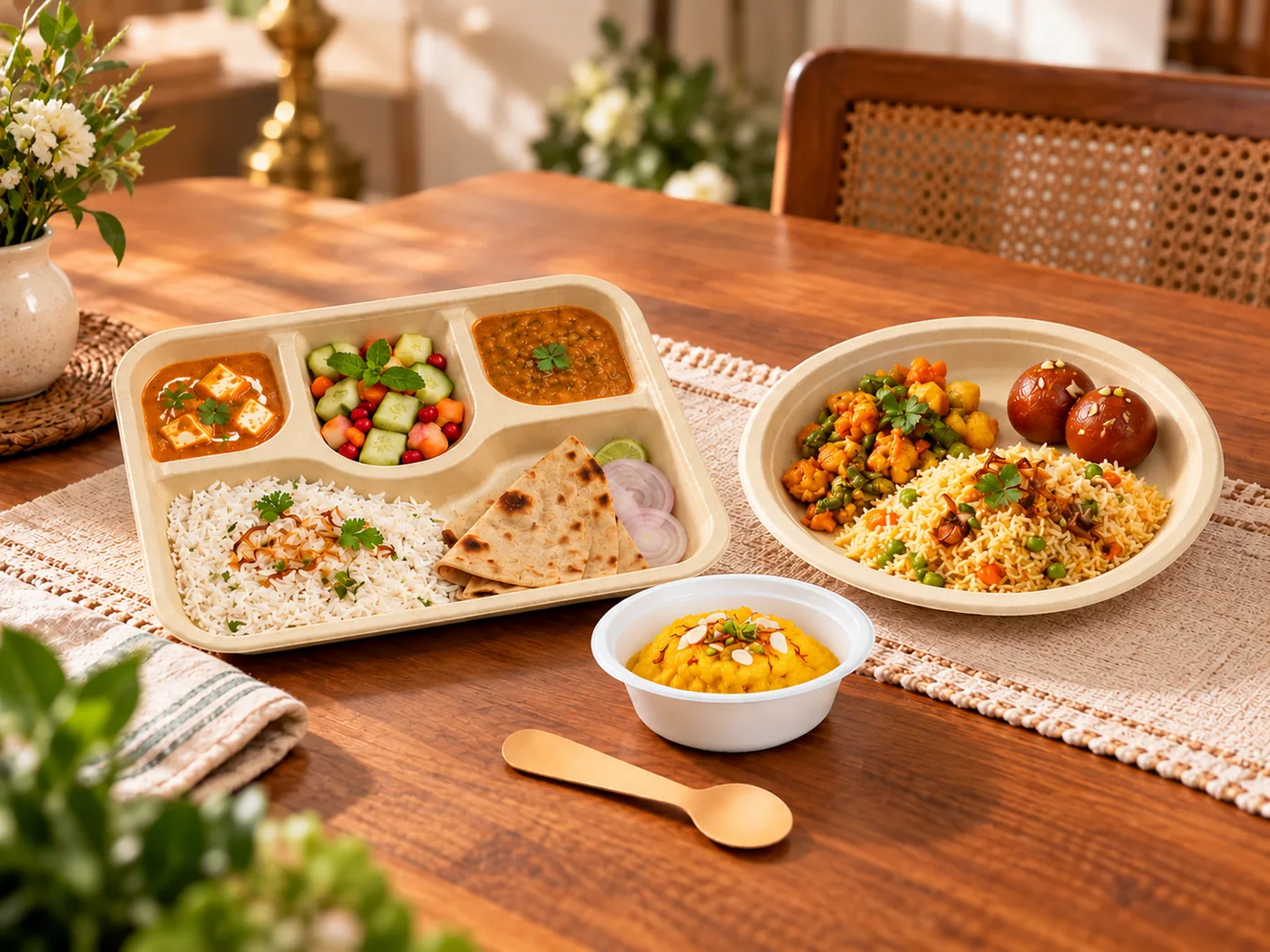
For wedding catering, use 10 inch bagasse plates or compartment trays for the main buffet, 6–7 inch plates for starters and sweets, and 8 oz bowls for dal, rasam or payasam. Order about 1.3 plates per guest for a buffet, more for long or multi-counter events, and test every format with your hottest, oiliest dish first.
How caterers pick bagasse plates for weddings: plate sizes by course, compartment trays, bowls for gravies, quantities per guest and testing with real food.
- Bagasse plates are moulded from sugarcane fibre left over after juice is extracted.
- Use 10 inch plates or compartment trays for mains, 6–7 inch for starters and desserts.
- Serve gravies, dal and payasam in bowls, not on flat plates.
- Plan around 1.3 plates per guest for a buffet; long events need more.
- Test with your hottest, oiliest dish and the longest time a guest holds the plate.
What are bagasse plates and why do caterers use them at weddings?
Bagasse is the fibrous residue left after sugarcane is crushed for juice. It is turned into pulp and then pressed into plates, bowls and trays using heat and moulds. The result is a rigid, matte plate that looks closer to stoneware than to a thin paper plate, which is why many caterers now use it for wedding buffets, receptions and sangeet dinners.
There is also a rules reason. India's single-use plastic ban, in force since 1 July 2022, covers plastic plates, cups, glasses, cutlery, straws, trays, stirrers and thermocol used for decoration. Caterers who once relied on plastic or thermocol plates for large functions have had to move to paper, leaf or moulded fibre options.
Bagasse sits well in that mix. It is stiffer than most paper plates, takes warm food without going limp straight away, and stacks neatly at a buffet counter. It is not a perfect material for every dish, though, so the plate size, shape and depth you choose matter as much as the material.
Which plate sizes work for each course?
For the main buffet, a 10 inch round plate is the usual choice. It holds rice or biryani, two dry sabzis, a roti or two and a little salad without food spilling over the rim. A 9 inch plate works for lighter menus, lunch functions and smaller servings, and it saves space on crowded counters.
For welcome snacks, chaat counters and live stations, a 6 or 7 inch plate is easier to hold while standing and talking. The same sizes suit desserts such as gulab jamun, halwa, cake slices and ice cream with a sweet. Smaller plates also cut waste, because guests take smaller portions and come back if they want more.
Arrowpack supplies moulded fibre round plates in 6, 7, 9 and 10 inch sizes, along with bowls and 3 to 8 compartment trays in bulk. Most wedding caterers stock at least two plate sizes so the starter counter and the main buffet are not drawing from the same stack.
Plates, compartment trays or bowls: which suits South and North Indian menus?
A compartment tray is a plate moulded with separate sections, usually three to eight, so dry items, gravies and sweets do not run into each other. For a full South Indian meal with rice, sambar, rasam, poriyal, kootu and payasam, a 5 or 8 compartment tray keeps everything in place and makes a buffet line move faster.
North Indian menus heavy on paneer gravies, dal makhani and raita usually work better with a flat 10 inch plate plus a separate bowl. Thin, hot liquids sit longer in a bowl without softening the base, and guests find a bowl easier to eat from than a shallow compartment.
Use 8 oz bowls for dal, sambar, rasam, kheer and payasam, and 16 oz bowls for soups, noodles or a one-bowl meal at a live counter. For a seated meal served by staff, a compartment tray often replaces both plate and bowl. For a standing buffet, a plate plus bowl gives guests more choice.
How do bagasse plates handle hot, oily and wet food?
Bagasse handles most hot Indian dishes well for the time a guest takes to eat. Dry items, rotis, biryani and thick gravies are rarely a problem. Trouble usually comes from very thin, very hot liquids or oily curries left standing for a long time, because moisture and heat slowly soften moulded fibre.
Industry guides agree that heat and liquid performance depends on the specific product: its thickness, depth and how it was pressed. Some bagasse bowls can take short reheating, but no supplier's plate should be assumed safe for every use. Treat each size and shape as a separate item and test it.
In practice, put rasam, thin dal and payasam in bowls, not on flat plates. Ask your kitchen not to ladle gravy straight from a boiling pot onto the plate. Keep plates in a dry place before service, because fibre that has absorbed humidity loses some stiffness, especially during monsoon weddings.
How many plates should you order for a wedding?
Event planning guides commonly suggest about 1.25 to 1.3 plates per guest for a buffet. Guests drop plates, take a fresh one for a second round, or pick up a plate and change their mind. For 500 expected guests, that means ordering roughly 650 main plates.
Long events and multi-counter menus need more. Buffet guides suggest 2 to 2.5 plates per guest when there are several main courses and sides, and up to 2.5 to 3 small plates per guest when the event is mostly starters and live counters. Add starter plates, dessert plates and bowls as separate lines, each with its own buffer.
Order by course and counter, not one total. A typical list has 10 inch plates for mains, 6 or 7 inch plates for starters and sweets, 8 oz bowls for dal and dessert, and a smaller stock of compartment trays for staff or VIP seating. Keep a few unopened cartons in reserve rather than opening everything at once.
What should you check before placing a bulk order?
Ask for samples of every size you plan to use. Serve your real menu on them, hold the plate the way a guest would with one hand, and leave a filled plate on a table for the length of a meal. Check for softening at the base, bending at the rim and any oil marks coming through underneath.
Check carton counts and storage space. Plates of different sizes pack differently, and a wedding order of several thousand pieces needs dry space near the venue. Plan delivery a day or two before the function so stock does not sit in a damp hall or vehicle.
Finally, be honest with your clients about disposal. Bagasse is plant fibre, but what happens to used plates depends on the waste handling at the venue and in the city. Arrowpack can send samples and quote plates, bowls and compartment trays in bulk; share your guest count, menu and event dates when you request a quote.
Frequently asked questions
What size bagasse plate is best for a wedding buffet?
A 10 inch round plate is the usual choice for the main buffet because it holds rice, two sabzis, rotis and salad without spilling. Use 6 or 7 inch plates for starters, chaat and desserts, and 8 oz bowls for dal, rasam or payasam.
Can bagasse plates hold hot gravy and dal?
Thick gravies are usually fine for the time it takes to eat. Thin, very hot liquids such as rasam or watery dal are better served in bowls, because moisture and heat slowly soften moulded fibre. Test samples with your actual menu before ordering.
How many plates do I need for 500 wedding guests?
Planning guides suggest about 1.25 to 1.3 main plates per guest for a buffet, so roughly 650 plates for 500 guests. Long events with many counters need more. Order starter plates, dessert plates and bowls separately, each with its own buffer.
Are bagasse plates allowed under India's plastic ban?
The single-use plastic ban in force since 1 July 2022 covers plastic plates, cups, cutlery, trays and thermocol decorations. Bagasse plates are moulded plant fibre, not plastic, which is why many caterers use them. Check any local municipal rules for your venue.
Should I use compartment trays or plates with bowls?
Compartment trays suit full South Indian meals and staff-served seating, because each item stays in its own section. For standing buffets with heavy gravies, a flat 10 inch plate plus a separate bowl gives guests more flexibility and keeps liquids off the plate.
Sources
- Phasing out of identified single use plastic items from 1 July 2022 — Press Information Bureau
- A comparison of bioplastic and bagasse based products for use as disposable foodware — EAI
- Can sugarcane bagasse tableware withstand high temperatures? — Bioleader
- If I am having a buffet dinner, how many plates should I order? — Party Rental Ltd
- How to calculate disposable tableware quantity for an event — JollyChef